

Wing Thye Woo began by describing how international cooperation has weakened while the need for joint solutions has grown. He highlighted problems within the World Trade Organization (WTO) and the need for cooperation on climate change, pandemics and artificial intelligence. Rivalry between the United States, China and Russia risks reducing other countries’ ability to influence developments.
Against this backdrop, Wing Thye Woo argued that small and medium-sized countries need to act together. A unilateral declaration of neutrality is not enough to withstand pressure from the great powers. Cooperation requires both economic and security clout, as well as a shared agenda that delivers tangible results.
His proposal, provisionally called the Asia Pacific Sustainability Partnership, centres on closer cooperation between Europe and the Association of Southeast Asian Nations (ASEAN), alongside countries such as Japan and Australia. Europe’s resources and experience of integration could be combined with Southeast Asia’s growing economies.
Under the proposal, the partnership would rest on three pillars: maintaining and developing rules-based trade with effective dispute settlement; working together within the United Nations on issues including peace and the environment; and supporting economic development and the green transition in poorer member countries. Wing Thye Woo stressed that wealthier countries need to help finance the transition if shared climate goals are to be achieved.
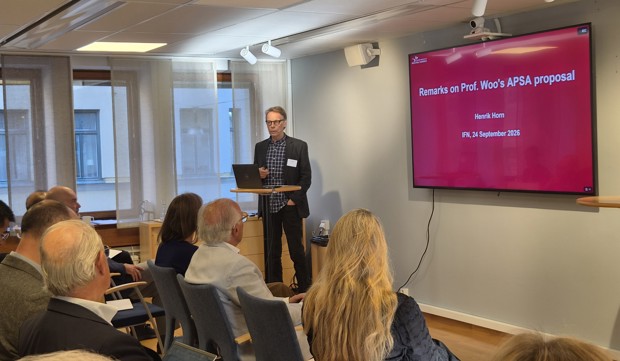
In his comments, Henrik Horn shared the ambition to find ways forward for international cooperation but identified several difficulties. He emphasised that the WTO’s problems go deeper than the absence of a functioning Appellate Body. The requirement for consensus among countries with very different circumstances and interests makes it difficult to reach decisions on deeper integration.
He also questioned whether the proposed partnership could deliver the deep integration sought by many advanced economies. Modern trade agreements largely concern regulations, product standards and other conditions within national borders. Negotiating such agreements is complex and often takes a long time.
As an alternative, Henrik Horn suggested closer cooperation between the EU and the countries party to the CPTPP trade agreement. Building on existing agreements would allow countries to draw on the extensive negotiating work already completed.
In the concluding discussion, Wing Thye Woo stressed that the changing security landscape could create stronger incentives for cooperation. He also highlighted Indonesia’s importance in securing support for a partnership in Southeast Asia, and the possibility of allowing countries to participate at different levels of integration. The aim, he argued, is to preserve countries’ room for manoeuvre and keep international cooperation alive even when the great powers struggle to agree.